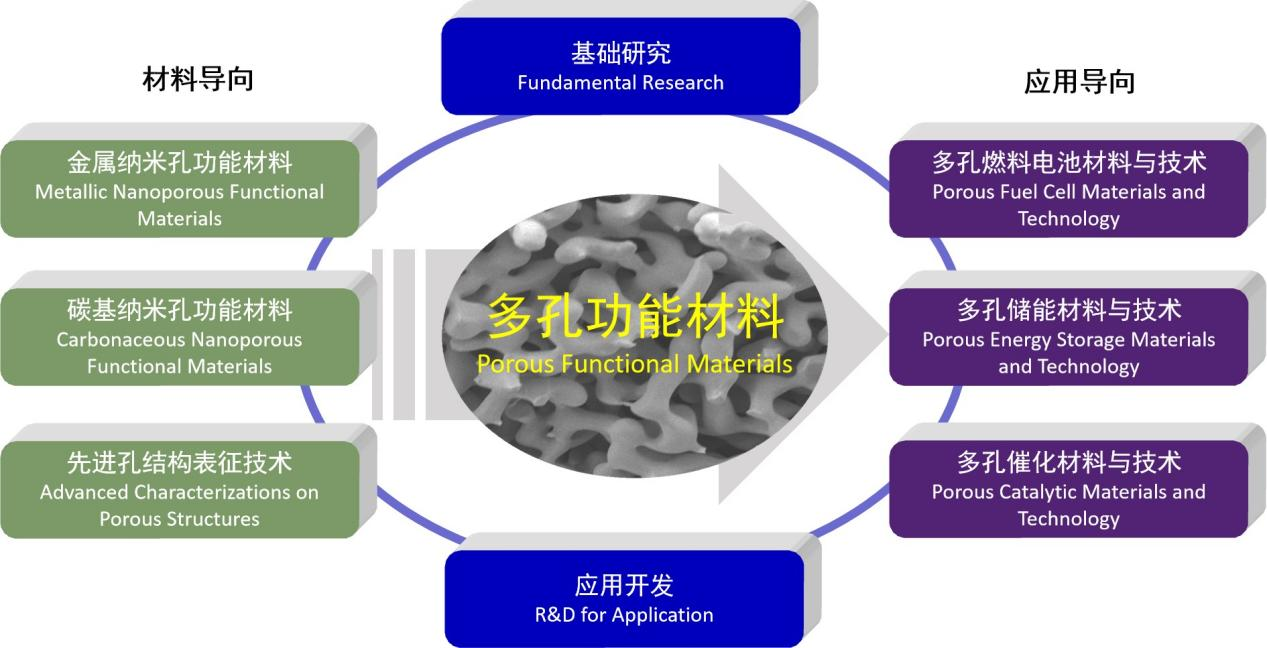
The Tianjin Key Laboratory of Advanced Functional Porous Materials is established based on Tianjin University of Technology, focusing on cutting-edge research of nanoporous materials. Unlike conventional nanomaterials, nanoporous materials possess abundant nanoscale interconnected pores within the bulk, and can exist both in nanoparticle form and in macroscopic solid forms. They exhibit high specific surface area, large porosity, low density, and rich active sites. Such materials cover inorganic, organic, and hybrid organic–inorganic systems, and have shown significant potential in catalysis, energy conversion and storage, and related emerging application fields.
The laboratory covers an area of approximately 5,000 m², with fixed assets exceeding RMB 60 million, and has established well-equipped research and characterization platforms. The laboratory currently has 20 professors and associate professors, 9 lecturers and postdoctoral researchers, 9 professional laboratory technicians, over 30 PhD students, and more than 150 master students. The research team includes over 30 high-level talents such as recipients of the National Distinguished Young Scientist Award, National Young Talents Program awardees, national talent program awardees, recipients of the State Council Special Allowance, Royal Society of Chemistry Fellows, national and provincial high-level overseas young talents, and other outstanding recognized talent schemes.
Since its establishment, the laboratory has undertaken more than 200 research projects, including major transformative technology projects and key special projects of the National Key R&D Program, as well as the National Distinguished Young and Excellent Young Scientist Funds (including overseas programs), with total research funding exceeding RMB 115 million.
In response to the national strategic goals of carbon neutrality and sustainable development, the laboratory focuses on major scientific questions and engineering challenges related to energy scarcity and greenhouse gas emissions, integrating fundamental research ("frontier science") and application-oriented technological innovation ("engineering translation"). Centered around porous functional materials, the laboratory conducts research in three major directions: porous fuel cell materials and technologies, porous energy storage materials and technologies, and porous catalytic materials and technologies - covering the full research chain from materials design and structural characterization to device applications and technology development.