Recently, a breakthrough achieved by the teams of Professor Tong-Bu Lu from the Institute for New Energy Materials and Low-Carbon Technologies at our universityononhigh-stability ruthenium-based oxygen evolution catalysts for water electrolysis, has been accepted by the top internationaljournalJournal of the American Chemical Society. The paper is titled “Understanding the Instability Origin for Design of Robust Pure RuO2Anode Catalyst in PEM Water Electrolysis”. The corresponding authors are Professor Tong-Bu Lu,Zi-You YuandXiao-Long Zhang, and the first author is PhD studentLin-LinWang.
Proton exchange membrane water electrolysis (PEMWE) for hydrogen production features high current density, high hydrogen purity and good compatibility with renewable energy sources, making it an important technical route for green hydrogen production. Nevertheless, the anodic oxygen evolution reaction (OER) operates under strongly acidic and high oxidation potential conditions, which has long relied on expensive iridium-based catalysts and thus raises the hydrogen production cost. Ruthenium-based catalysts exhibit low cost and outstanding OER activity, and are regarded as highly promising alternatives to iridium-based catalysts. However, their insufficient stability limits their practical application in PEMWE.
To address this challenge,this study reveals that chlorine residues from precursors are a key factor responsible for the instability of RuO2.As the most common and cheapest Ru-based precursor, ruthenium chloride (RuCl3) has been widely used to prepare RuO2catalysts. However, the Ru−Cl coordination interaction usually leads to the inevitable Cl residues during the catalyst synthesis.Crucially, we demonstrate that the gradual leaching of these Cl residues during OER is the primary trigger for the formation of anion vacancies, which in turn dramatically accelerates both Ru dissolution and lattice oxygen loss, ultimately causing structural collapse and rapid performance decay. Armed with this mechanistic insight, we developed a small-molecule-assisted synthesis to produce truly Cl-free RuO2with complete elimination of Cl residues. The resulting catalyst retains its pristine activity after 80,000 accelerated degradation cycles and delivers stable PEMWE operation at 500 mA cm−2for 500 h.This work not only resolves the fundamental instability origin of RuO2but also establishes chloride elimination as a critical design principle for durable oxide electrocatalysts beyond the RuO2system.
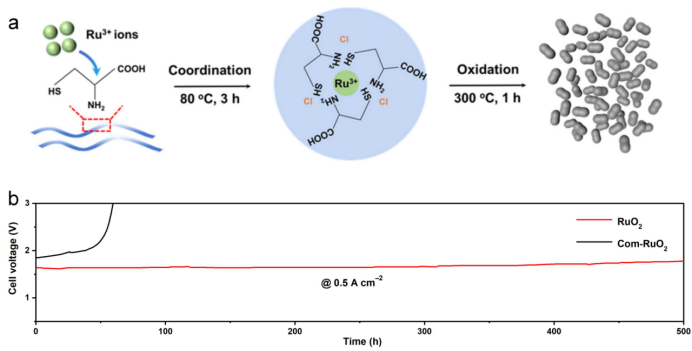
This work has been accepted for publication, marking a significant new breakthrough achieved by our research team in the fields of materials chemistry and new energy catalysis.
Journal of the American Chemical Society (JACS)is the flagship journal of the American Chemical Society (ACS). It enjoys high academic influence in chemistry and publishes high-quality original research across catalysis, energy, materials and related disciplines.
